

CFX-35 Desert Lance: Train for the Threat. Then Train for Its Evolution.
In Flight Test | IOC June 2026
The Desert Lance family replicates the Shahed-101 class loitering munition — a smaller-form-factor, battlefield-range one-way attack threat distinct from the long-range Shahed-136. The CFX-35 Desert Lance replicates the original piston-powered Shahed-101 — the threat that shaped first-generation acoustic C-UAS detection. The EFX-20 Desert Lance replicates the electric variant — the evolved threat that defeats the acoustic sensors your operators just trained on.
The Training Problem
Your Acoustic Sensors Were Built for a Drone that Sounded Like a Moped. That was then… Electric is now!
The original Shahed-101 was a piston-powered loitering munition — smaller-form-factor, longer ranges, patient. It loitered. It delayed. It struck on its own timeline. And it made a sound. C-UAS defenders spent years optimizing acoustic detection systems to find it — listening for the distinctive signature of a small two-stroke engine orbiting overhead.
Then, the threat evolved. The Shahed-101 electric variant replaced the piston engine with an electric motor. The acoustic signature that detection systems were tuned to find is gone. What remains is a low hum at close range, a small radar cross-section, and a thermal signature from a cool-running electric motor — a target that requires a fundamentally different detection approach than the one operators trained for.
Training against only the original threat produces operators who are proficient against a system that is already being superseded in the field. Training against only the electric variant skips the foundational detection and engagement proficiency that the piston variant builds.
The Desert Lance family trains for both — in sequence, as the threat actually evolved.
What the Desert Lance Family Is
Two Variants. One Threat Class. A Complete Training Pipeline.
The Desert Lance family replicates the Shahed-101 class — the tactical loitering munition threat that is distinct from the strategic long-range Shahed-136 class that ABSI’s Nomad addresses. The Shahed-101 is a smaller-form-factor, battlefield-range system capable of carrying a warhead. It operates at lower altitudes, shorter ranges, and presents a different radar cross-section and visual signature than Shahed-136 class systems. Both threat classes are active in current conflicts. Both require dedicated training capability. Neither can substitute for the other.
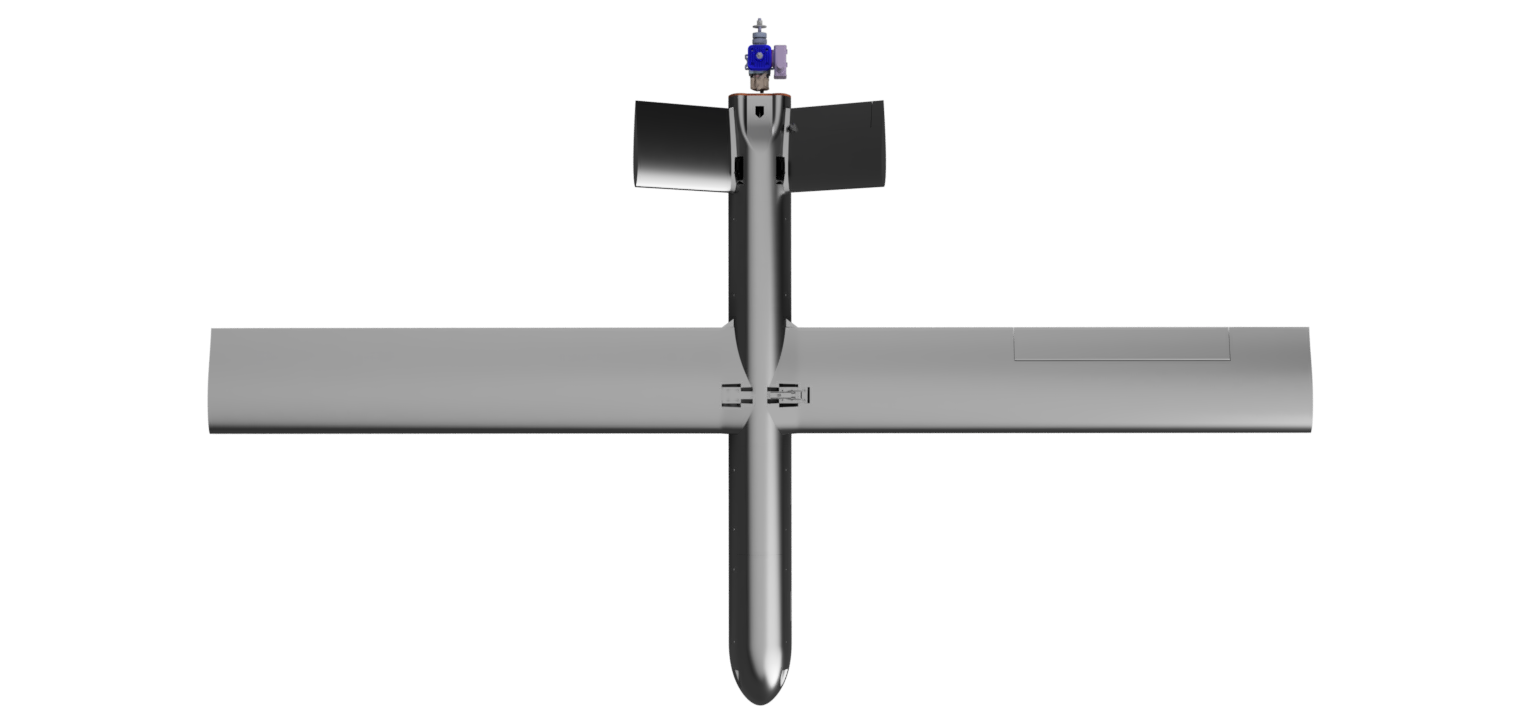
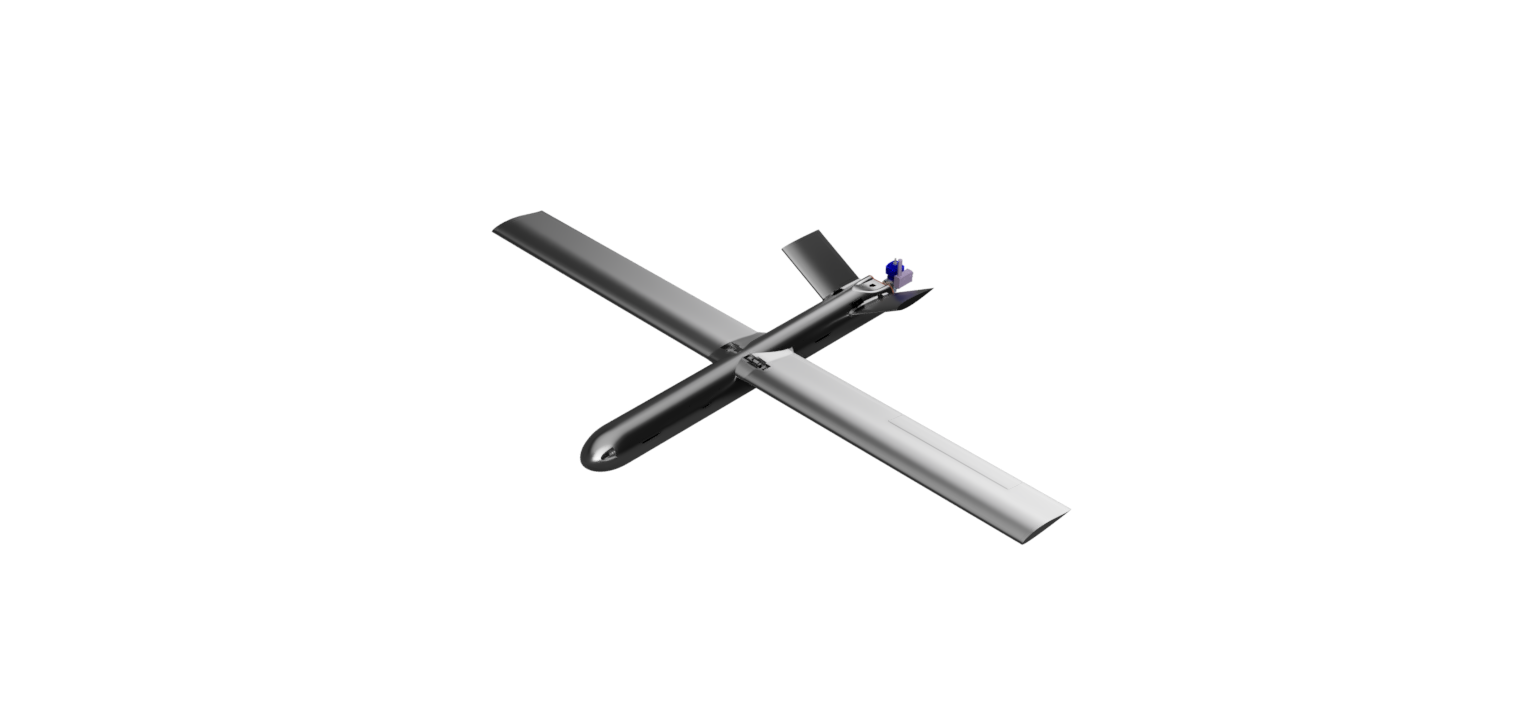
The CFX-35 Desert Lance replicates the original piston-powered Shahed-101 configuration — the two-stroke acoustic signature, the patient loiter profile, and the loiter-to-strike terminal sequence. This is the threat that defined the first-generation C-UAS acoustic detection problem and remains operationally relevant. It is ABSI’s first production variant and the foundation of the Desert Lance training pipeline.
The EFX-20 Desert Lance replicates the evolved electric Shahed-101 — the low-acoustic-signature variant that defeats the detection systems operators built against the piston threat. Electric propulsion with a 20-inch propeller. Minimal acoustic output. Cool-running electric motor with reduced thermal signature. The same Shahed-101 form factor and flight profile but now engineered to approach without the warning that acoustic sensors provide. Desert Lance is in development immediately following Desert Lance, with IOC anticipated in 2026.
Unlike simplified target systems or modified commercial platforms, both Desert Lance variants are purpose-built and U.S.-manufactured — engineered to replicate the specific form factor, flight behavior, and propulsion signature of the Shahed-101 class with operational fidelity.
NDAA-compliant variants of both Desert Lance and Desert Lance will integrate ABSI’s own U.S.-manufactured flight controller from the outset — developed to ABSI’s flight controller standard, meaning no legacy avionics to transition upon production release. Remaining avionics components are sourced from NDAA-compliant supply chains, with a full ABSI-developed avionics stack on the roadmap.
Variant Comparison
| Category | CFX-35 Desert Lance | EFX-20 Desert Lance |
|---|---|---|
| Designation | CFX-35 Desert Lance | EFX-20 Desert Lance |
| Propulsion | Two-stroke piston engine — 35cc | Electric motor — 20-inch propeller |
| Threat Replicated | Shahed-101 (original piston variant) — the threat that shaped first-generation acoustic C-UAS detection | Shahed-101 electric variant — the evolved threat that defeats acoustic-optimized detection systems |
| Detection Challenge | Acoustic signature replication — trains operators on the known threat profile | Low acoustic signature — forces transition to radar and thermal detection; renders acoustic-optimized sensors insufficient |
| Airframe | Fixed-wing, Shahed-101 form factor | Fixed-wing, Shahed-101 form factor |
| Status | In Flight Test | IOC June 2026 | In Development | IOC Anticipated 2026 |
| Procurement | NDAA-compliant and C-UAS training-optimized configurations | NDAA-compliant and C-UAS training-optimized configurations |
Both variants share the same Shahed-101 form factor, loiter-to-strike flight profile, and recoverable airframe design — enabling cost-effective high-frequency training use across the full engagement sequence without consuming the airframe on every sortie
Key Capabilities
-
Shahed-101 Class Behavioral Fidelity
Replicates the specific form factor, loiter profile, and terminal strike behavior of the Shahed-101 — the tactical OWA threat class distinct from Shahed-136 long-range systems. Active in various conflict operations worldwide.
-
Threat Evolution Training Pipeline
CFX-35 Desert Lance trains operators on the original acoustic threat. EFX-20 Desert Lance trains operators on the electric variant that defeats those same acoustic sensors. Sequential training against both variants builds complete proficiency across the threat’s evolution.
-
Extended Decision Timelines
Forces operators to detect, track, and engage over extended periods — testing sustained attention, identification confidence, and engagement timing against a system designed to exploit all three.
-
Recoverable Airframe / High Training Frequency
Recoverable design enables cost-effective repeated training sorties. Terminal strike profiles available when training objectives require full loiter-to-strike engagement replication.
-
Two Procurement Configurations
Both variants available in NDAA-compliant variant for standard DoD procurement, and C-UAS training-optimized variant under the Section 817 FY2023 NDAA exemption — for maximum threat fidelity including authentic emissions.
System Specifications
Shared Specifications — Both Variants
| Airframe Type | Fixed-wing — Shahed-101 class form factor and flight geometry |
| Threat Class | Shahed-101 loitering munition — battlefield-range, smaller-form-factor than Shahed-136 class |
| Warhead Equivalent | Replicates Shahed-101 payload form factor and terminal approach profile |
| Flight Profile | Extended loiter with transition to terminal dive/strike on command or mission trigger |
| Approach Profile | Low-to-moderate speed, deliberate, patient ingress — replicates Shahed-101 loitering munition employment |
| Airframe Design | Recoverable — supports repeated training sorties; terminal strike profile available |
| Launch Options | Ground-origin deployment. Catapult launch capability in development — availability anticipated Fall 2026. |
| Payload Bay | Modular — rapid integration of instrumentation and mission payloads |
| Other Avionics | ESCs (used in CFX only) and GPS sourced from NDAA-compliant supply chains. Full ABSI-developed avionics stack on roadmap. |
Variant-Specific Specifications – CFX-35 Desert Lance
| Platform | CFX-35 Desert Lance |
| Propulsion | Two-stroke piston engine — 35cc |
| Acoustic Signature | Replicates original Shahed-101 piston acoustic profile |
| Detection Challenge | Trains acoustic-based detection and engagement |
| Flight Controller | ABSI-designed, U.S.-manufactured — integrated from outset |
| NDAA-Compliant Variant | Supply chain validated for NDAA compliance. Standard DoD procurement — no exception-to-policy required. |
| C-UAS Training Variant | Authentic adversary component set. Procured under Section 817, FY2023 NDAA exemption for C-UAS surrogate testing and training. |
| IOC | June 2026 — currently completing flight test |
Detailed performance parameters, system configurations, and integration options are tailored to mission requirements. Contact our team to discuss how Desert Lance and Desert Lance can support your specific test, training, or evaluation objectives.
Variant-Specific Specifications – EFX-20 Desert Lance
| Platform | EFX-20 Desert Lance |
| Propulsion | Electric motor — 20-inch propeller |
| Acoustic Signature | Minimal acoustic output — low hum at close range replaces the distinctive two-stroke signature acoustic sensors were tuned to detect |
| Detection Challenge | Forces transition to radar and thermal detection; renders acoustic-optimized sensors insufficient. Cool-running electric motor produces reduced thermal signature alongside low radar cross-section. |
| Flight Controller | ABSI-designed, U.S.-manufactured — integrated from the outset. No legacy avionics to transition upon production release. |
| Other Avionics | ESCs and GPS sourced from NDAA-compliant supply chains. Full ABSI-developed avionics stack on the roadmap. |
| NDAA-Compliant Variant | Supply chain validated for NDAA compliance. Standard DoD procurement — no exception-to-policy required. |
| C-UAS Training Variant | Authentic adversary component set — including authentic electric motor RF and acoustic signature profile of the evolved Shahed-101 electric variant. Procured under Section 817, FY2023 NDAA exemption for C-UAS surrogate testing and training. |
| IOC | Anticipated 2026 — in development immediately following CFX-25. Engage now to shape development priorities and secure early access. |
Use Cases - Applications
Primary
-
Shahed-101 class loitering munition threat emulation — piston and electric variants
-
Acoustic detection training and validation against original Shahed-101 piston profile (CFX-35)
-
Radar and thermal detection training against low-acoustic-signature electric OWA threats (EFX-20)
-
Development and validation of C-UAS TTPs across the full Shahed-101 threat evolution
Secondary
-
Extended-duration operator tracking and decision-making training against patient loitering threats
-
Live-fire engagement against delayed-approach, loiter-to-strike profiles
-
Multi-system coordinated scenarios — loitering munition layer combined with swarm and high-speed threat profiles within ABSI GCS ecosystem
-
Sensor and detection system evaluation against low-signature, low-RCS aerial targets
ABSI Aerial Targets Ecosystem
One control system. Every threat class. Seamless training at scale.
The Desert Lance family is the Shahed-101 class loitering munition layer within the ABSI aerial target ecosystem — the tactical OWA threat that complements Gnat Storm’s swarm saturation, Pit Viper’s high-speed tactical profiles, and Nomad’s Shahed-136 class long-range OWA fidelity. Within the common GCS architecture, Desert Lance can be layered into coordinated multi-threat scenarios that replicate how adversaries actually sequence their attacks — mass and saturation first, patient loitering munitions second, long-range strategic OWA third.
Acquisition Pathway
CFX-35 Desert Lance: IOC June 2026. EFX-20 Desert Lance: IOC Anticipated 2026.
The CFX-35 Desert Lance is completing flight test with initial operational capability anticipated June 2026. The EFX-20 Desert Lance is in development immediately following the piston variant, with IOC anticipated in 2026. Both variants will be available to U.S. government customers, prime contractors, and authorized partners through the Defense Logistics Agency’s Special Operational Equipment Tailored Logistic Support (DLA SOE/TLS) program and direct contracting pathways.
Program offices with FY2026 requirements should engage ABSI now — for CFX-35 to secure June delivery access, and for EFX-20 to shape development priorities and influence delivery timelines. Expanded launch options including catapult capability are in development with availability anticipated Fall 2026.
Both variants available in NDAA-compliant and C-UAS training-optimized configurations. Your acquisition pathway determines your configuration — not your vendor.
Not sure which configuration fits your program?
The C-UAS training-optimized variant is available under Section 817 of the FY2023 NDAA — a statutory exemption that gives counter-UAS training programs explicit authority to procure authentic adversary component systems without standard NDAA supply chain restrictions. Contact ABSI and we’ll walk your team through the pathway.

Persist. Delay. Strike.
The Desert Lance family trains your operators against the Shahed-101 threat as it exists today — and as it already evolved to defeat first-generation detection. CFX-35 IOC June 2026. EFX-20 IOC anticipated 2026. Engage now.